
The worksheet is still warm from the copier and half the class is already staring at the clock. A math scavenger hunt for students uses the same skills, but the numbers are on the door, the desk, and the window. You can run it in one period, and you do not need a new app on every phone.
Why a math scavenger hunt works
Students stand up and do maths on things they can touch. A length, an angle, or a price tag is harder to guess than a row on a sheet, and the wrong answer is obvious when they look again. You still mark the work. You just stop handing out another page.
25 math scavenger hunt ideas
Use the ones that match the lesson. Skip any stop that needs a tool the room does not have.
Geometry and shapes
1. Right angle.. Ask them to photograph one square corner in the room and name the degrees. A book, a window, or a tile all work. 2. Count the edges.. Pick one object, such as a desk or a tissue box, and ask for the number of edges. They have to walk around it. 3. Longer wall.. They pace the longer wall, then the shorter one, and say which is longer and by about how many steps. 4. Parallel lines.. Find two lines that will not meet, such as the sides of a window or the edges of a floor tile, and name them. 5. More than four sides.. Photograph a shape with more than four sides. A stop sign drawing, a hexagon tile, or a cut-out on the board is enough. 6. Two corners.. Compare a door corner with a book corner. Are they the same kind of angle, or is one more open? 7. Perimeter of a book.. Measure each side in centimetres and add. The answer is a number, not a photo of the cover.
Numbers and arithmetic
8. Sum on a card.. Write 18 + 27 on a card at a desk. They type the total. Change the numbers for the next class. 9. Running total.. Three cards around the room show 12, 9, and 15. The last stop asks for the sum of all three. 10. Price-tag sum.. Stick three paper price tags on a class shop display. They add the prices and type the total in cents or in dollars, and you say which. 11. Closer to which.. Ask whether the books on one shelf are closer to 10, 100, or 1,000. They count if they disagree. 12. Make 24.. Digits are written on four sticky notes. They use each digit once, with any operations, to make 24, and type 24 when they have it. 13. Even chairs.. Count the chairs at one table. Type the number, then say whether it is even or odd in the next stop. 14. Missing sign.. The card reads 8 _ 3 = 24. They type the operation, or they type 8 times 3 if you would rather have words.
Fractions, measurement, and data
15. Desk in centimetres.. Measure the long side of the desk. Accept a small range, because rulers slip. 16. Half as long.. Find something about half as long as a 30 cm ruler. They name the object and the length they measured. 17. Estimate, then measure.. Guess the width of the door in centimetres, write the guess, then measure and type the real width. 18. Class tally.. Each student picks left or right at one stop. The last group counts the choices and says which side won. 19. Half full.. A jug or a drawn bottle is marked. They say whether it is closer to one half or one quarter. 20. Which fraction.. Two strips of paper, one twice as long as the other. They type the shorter one as a fraction of the longer one.
Word problems and logic
21. Blank in a sentence.. "There are 6 tables and 4 pencils on each table. There are ___ pencils." They type the number. 22. Three-digit lock.. Three short clues around the room give the hundreds, tens, and ones. The last stop is the three-digit number. 23. Which does not belong.. The card shows 4, 9, 16, 20. They type the one that is not a square number. 24. Empty chairs.. "Each table has 4 chairs and 2 are empty. How many people can sit?" They type the number. 25. Check the total.. The door has a number. It should match the running total from earlier stops. If it does not, they go back to the card they rushed.
How to run a math scavenger hunt without an app download
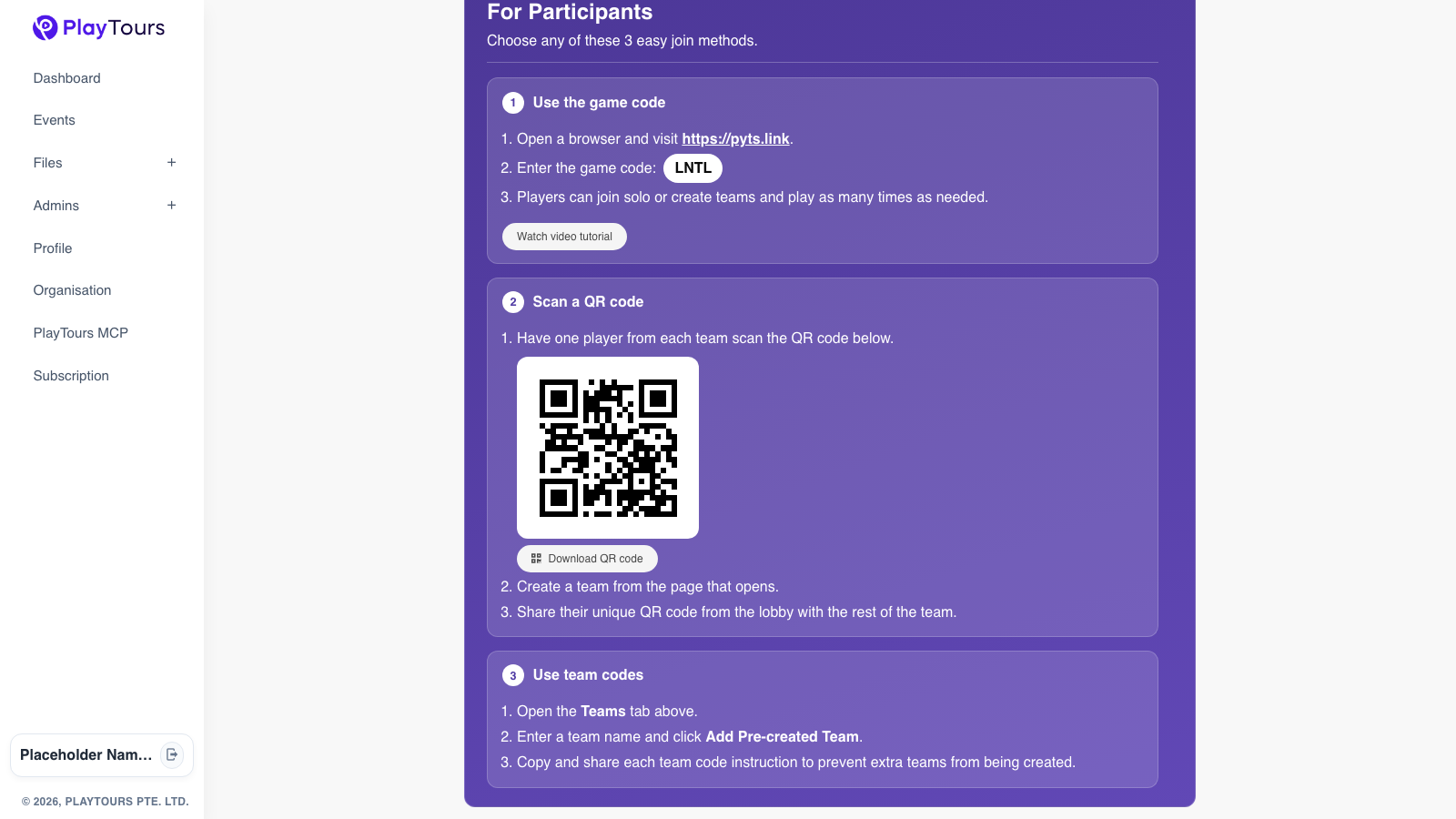
Print one QR large and put it on the board. Students open it in the browser they already have. Nothing to install, and a student without a phone shares a partner's. One shared phone is one device.
Use number-answer stops for anything with a single numeric answer. The hunt checks the number. For a measurement, allow a small range around the answer so a desk of 59 cm still counts when you expected 60.
On the free plan, 25 devices can be in the hunt at once. A bigger class shares phones, or the second half starts when the first half is done.
If you do not want to build every stop from a blank page, describe the maths lesson in QuickBuild and it drafts a route. Read every answer before the class comes in. You can run that as a free scavenger hunt app for teachers: one code on the board, number answers the hunt can check, and you stay at the front.
Quick tips for marking and fairness
If a stop is a photo, look at it before the points count. A picture of the ceiling is not a right angle. The leaderboard shows who has finished, which is enough for a class game. It is not a grade.
Groups of two or three are calmer than one phone each. Tell them where to sit when they finish, or the fast group will invent extra stops.
When you want the list and the browser join in one place, use a free scavenger hunt app for teachers.