

Both PlayTours and Actionbound offer GPS-based scavenger hunts for tourism, but they differ significantly in how visitors access and experience them. This PlayTours vs Actionbound for tourism comparison breaks down the key differences across six critical areas so you can decide which platform fits your tourism operation.
Table of Contents
- Visitor Access: App Download vs Browser-Based
- GPS and Location Features
- Content Types and Task Variety
- Pricing and Scalability
- Offline Capabilities
- Tour Management and Reusability
1. Visitor Access: App Download vs Browser-Based — A Key PlayTours vs Actionbound for Tourism Difference
Key difference: PlayTours runs entirely in the mobile browser with no download required. Actionbound requires visitors to install a native app from the App Store or Google Play before they can participate.
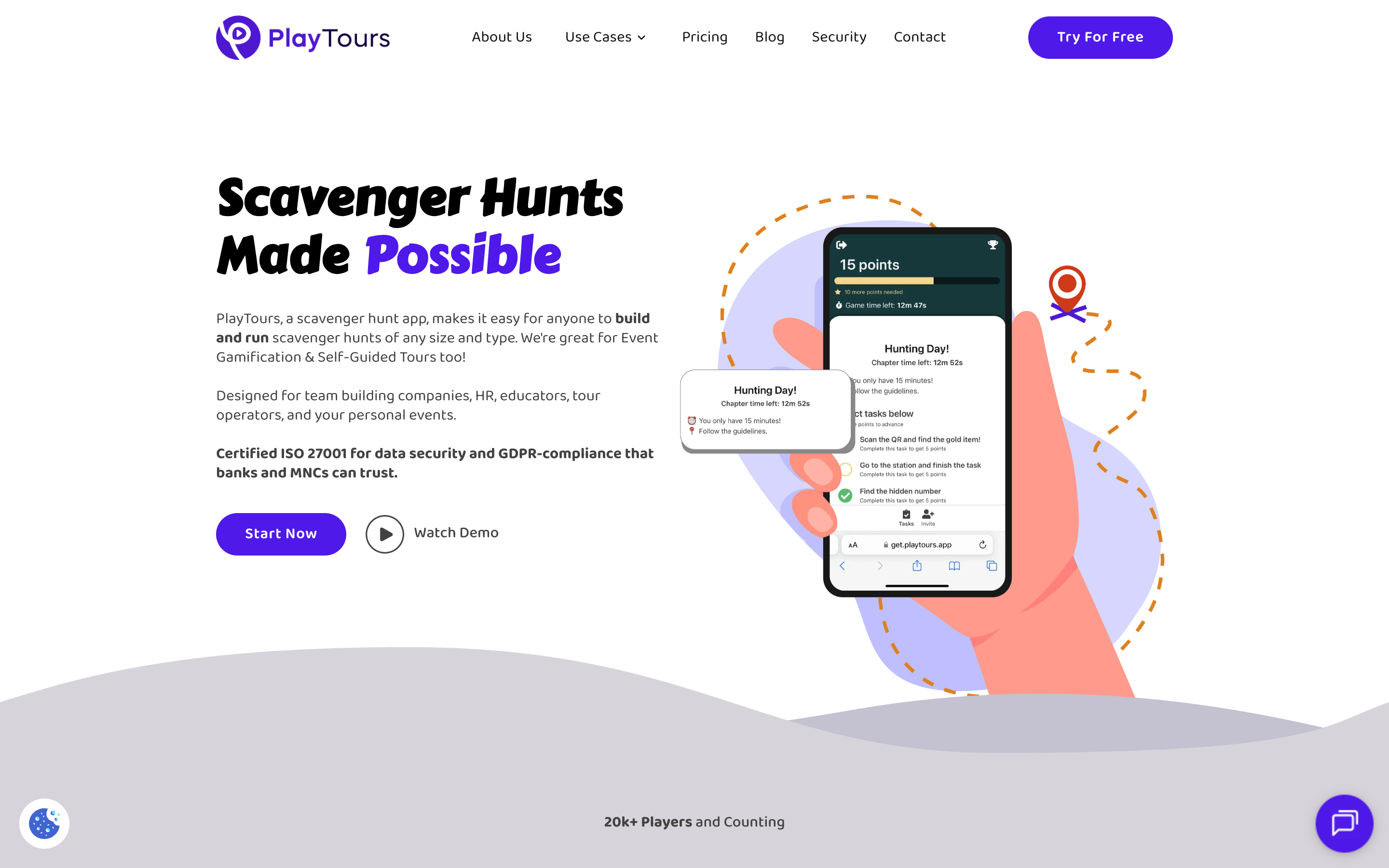
How PlayTours does it: Visitors join a tour by tapping a link or scanning a QR code. The experience loads instantly in their phone's browser regardless of whether they use iOS, Android, or even a tablet. There is no app store visit, no download wait, no storage space consumed, and no account creation required. For tourism operators, this means walk-in visitors at a visitor centre, museum front desk, or tourism booth can start exploring within seconds. The platform also supports auto-translate into multiple languages, making it accessible to international tourists without additional setup.
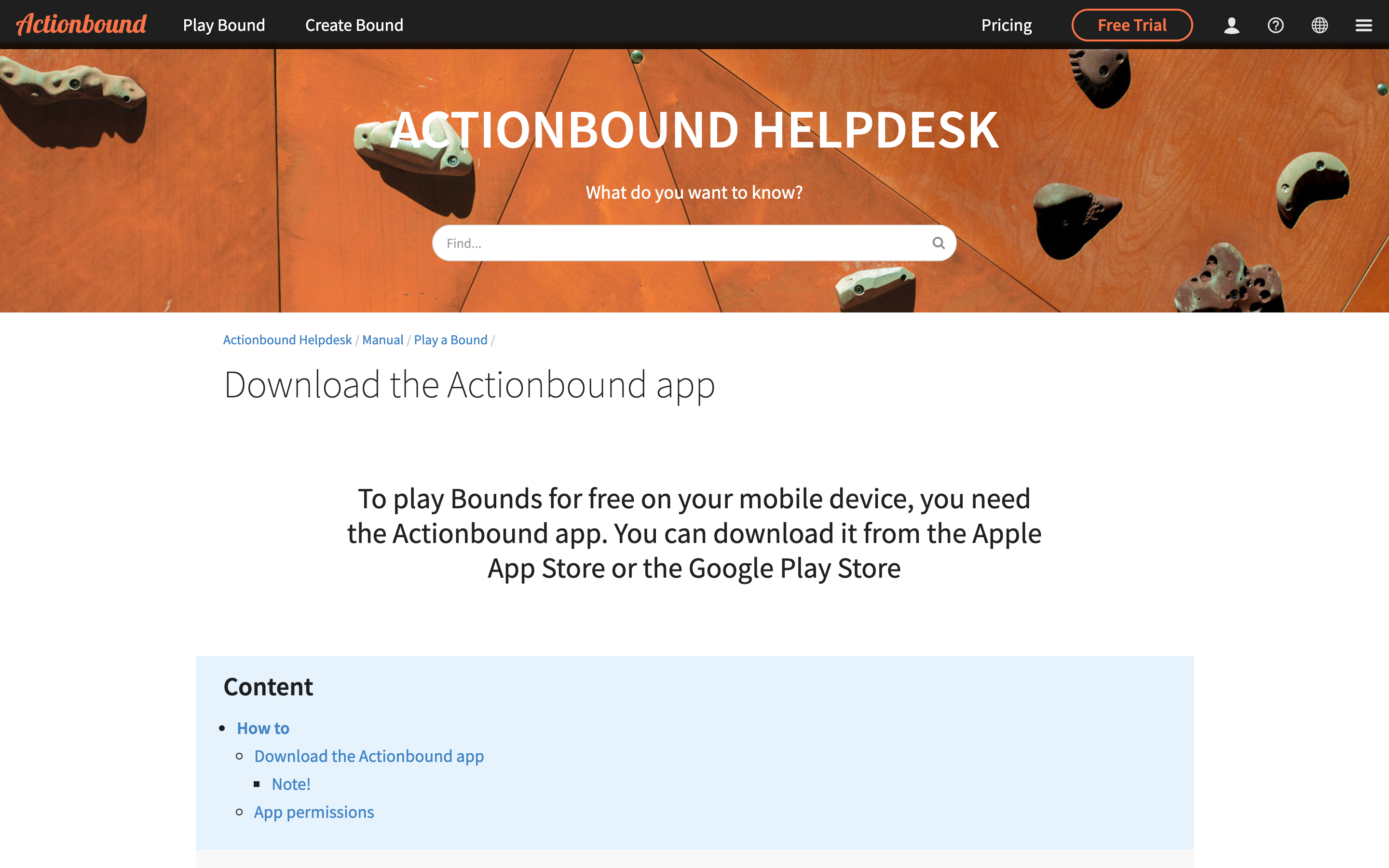
How Actionbound does it: Visitors must download the Actionbound app from the iOS App Store or Google Play Store before they can play a Bound (Actionbound's term for a tour). While the app is free to download, this step introduces friction. Tourists on limited data plans, visitors with older devices running out of storage, or those who prefer not to install temporary apps may skip the experience entirely. Actionbound does allow playing public Bounds without registration, but the app download gate remains.
Why this matters for tourism: Tourism is a high-friction environment. Visitors are often on the move, using mobile data, and unwilling to install an app they will use once. A 2026 study on travel technology trends found that frictionless, zero-download experiences significantly increase participation rates in self-guided tourism activities [1]. For city-wide tourism campaigns, museum trails, and destination marketing activations, browser-based access consistently outperforms app-download models in completion rates.
2. GPS and Location Features in the PlayTours vs Actionbound for Tourism Comparison
Key difference: Both platforms support GPS checkpoints and geofencing, but PlayTours delivers these through the browser while Actionbound relies on its native app's GPS capabilities.
How PlayTours does it: PlayTours supports GPS check-ins through two task types: "direction" tasks (where the location is shown on a map and players navigate to it) and "location" tasks (where the destination is hidden and players must find it using clues). Each GPS task has a configurable radius (typically 20-200 metres), and the platform supports geofencing with proximity triggers. GPS tasks can be combined with QR code scanning, photo uploads, or quiz questions for layered verification. The browser-based GPS works reliably on any modern smartphone with location services enabled.
How Actionbound does it: Actionbound's native app provides GPS-based check-ins with configurable radius and geofencing. The app can use the device's GPS chip directly, which can offer slightly more consistent performance in areas with weak signals. Actionbound also supports QR code scanning as an alternative location verification method. However, because the experience is app-based, GPS accuracy depends on the device's hardware and the app's background location permissions, which some users may deny.
Why this matters for tourism: Tourism locations vary widely - from dense city centres with tall buildings (where GPS can be unreliable) to open parks and rural heritage sites. The ability to configure radius, combine GPS with QR verification, and offer visible or hidden location modes gives operators flexibility. PlayTours' "Allow Completion Outside Radius" option (GPS-soft mode) is particularly useful for locations where GPS is known to be unreliable, ensuring visitors are not penalised for technical limitations.
3. Content Types and Task Variety
Key difference: PlayTours offers over 30 task types including AI-judged photo tasks, object recognition, and jigsaw puzzles. Actionbound focuses on core task types suited to educational and cultural trails.
How PlayTours does it: PlayTours provides a broad range of task types: photo uploads (with optional AI judging via image recognition), video recording, audio recording, quiz questions (multiple choice, fill-in-the-blanks, text answers), QR/barcode scanning, GPS check-ins, word searches, matching pairs, sorting exercises, scrambled phrases, jigsaw puzzles, combination locks, and crossword puzzles. Tasks can be combined with GPS proximity requirements, access codes, and time limits. The platform also supports AI-judged photo tasks where the system checks if a photo contains a specific object (e.g., "a red fire hydrant" or "a bronze statue").
How Actionbound does it: Actionbound offers photo tasks, quiz questions (multiple choice and text), QR code scanning, GPS check-ins, surveys, and info pages. Its task set is well-suited to educational trails and museum tours where the primary interaction is answering questions and scanning codes. Actionbound also supports "info pages" that display multimedia content without requiring player interaction, useful for storytelling segments. However, it lacks the creative task types (video recording, audio, jigsaw puzzles, object recognition) that make tourism experiences more engaging for modern visitors.
Why this matters for tourism: Visitor engagement drops when every tour stop follows the same pattern. A mix of photo challenges, creative tasks, puzzles, and knowledge questions keeps participants engaged throughout a 60-90 minute tour. For family tourism, task variety is especially important - children and adults engage differently, and platforms with more interaction types can cater to both.
4. Pricing and Scalability
Key difference: PlayTours charges based on active devices with no per-player fees. Actionbound uses a license-based model that can become expensive for large or seasonal tourism operations.
How PlayTours does it: PlayTours offers tiered pricing based on concurrent active devices: a free plan (25 active devices, full features, commercial use allowed including paid tourism activations), then $35/month (5 devices), $79/month (60 devices), and $159/month (120 devices). There are no per-player fees - a single device can be used by an entire team or family. For tourism operators running multiple daily tours, this means predictable monthly costs regardless of how many visitors participate. The platform also supports one-time payment options for organisations that prefer not to commit to monthly subscriptions.
How Actionbound does it: Actionbound offers a free tier with limited features (not for commercial use) and paid licenses starting at approximately $76 for 10 devices. Pricing scales with the number of licenses purchased, and commercial use requires paid plans. For a tourism operator running tours throughout a season, the cost can add up quickly - especially if each visitor or small group needs a separate license. Actionbound's pricing is more suited to educational institutions with predictable, small-group usage than to tourism operations with fluctuating visitor volumes.
Why this matters for tourism: Tourism is seasonal. A beach town may see 10,000 visitors in July and 200 in January. Per-player or per-license pricing models penalise operators during peak season, while device-based pricing with no per-player fees keeps costs stable. For destination marketing organisations running city-wide campaigns, the ability to scale to hundreds of simultaneous participants without incremental per-person costs is a significant advantage.
5. Offline Capabilities
Key difference: Both platforms support offline functionality, but through different mechanisms - PlayTours uses browser caching while Actionbound uses native app pre-loading.
How PlayTours does it: PlayTours caches game content in the browser so that once a tour is loaded, it continues to work in areas with poor or intermittent connectivity. This is particularly useful for tourism locations such as hiking trails, rural heritage sites, underground caves, or areas with limited mobile data coverage. The browser cache persists for the duration of the session, and GPS check-ins continue to function even when the network is weak.
How Actionbound does it: Actionbound's native app allows organisers to pre-load Bounds onto devices before the tour begins. Visitors can download the Bound content while connected to WiFi and then play entirely offline. This is a robust solution for locations with no connectivity at all. However, it requires advance planning - visitors must remember to download the Bound before heading out, and the organiser must ensure devices have sufficient storage space.
Why this matters for tourism: Many of the world's most interesting tourism locations have limited mobile data coverage - national parks, remote historical sites, underground attractions, and rural cultural trails. Both platforms address this, but in different ways. PlayTours' approach works for visitors using their own phones (no pre-planning needed), while Actionbound's approach works best when the organiser provides pre-loaded devices or when visitors can be instructed to download content before arrival.
6. Tour Management and Reusability
Key difference: PlayTours offers cloning, template saving, scheduling, and bulk editing for managing multiple tours across seasons. Actionbound provides cloning and version history but with less flexibility for large-scale operations.
How PlayTours does it: PlayTours allows operators to clone existing tours, save templates for reuse, schedule tours for specific dates and times, and bulk-edit tasks across multiple tours. For a tourism operator running different versions of a city tour for different seasons (summer vs winter routes, holiday-themed editions, language-specific versions), these features reduce setup time significantly. The platform also supports chapter-level shuffling and task-level shuffling to prevent crowding at popular stops during peak hours.
How Actionbound does it: Actionbound supports tour cloning and template saving, allowing organisers to duplicate existing Bounds and modify them for different groups. Version history is available, so changes can be tracked and rolled back if needed. However, Actionbound's management tools are designed more for individual educators creating a few Bounds than for tourism operators managing dozens of tours across multiple locations and seasons.
Why this matters for tourism: A tourism operator might run a heritage trail in three languages, a family-friendly version, a school group version, and a corporate team-building version - all based on the same route. The ability to clone, template, and schedule these variations without rebuilding from scratch is essential for operational efficiency. Bulk editing features also matter when updating information across multiple tours (e.g., updating opening hours or adding a new point of interest).
Which Platform Should You Choose?
The right choice depends on your specific tourism operation and visitor profile.
Choose PlayTours if: You run a tourism operation where visitors use their own phones, you want maximum participation by removing download friction, you need predictable pricing that scales with seasonal demand, and you value task variety to keep visitors engaged. PlayTours is particularly strong for city-wide tourism campaigns, destination marketing activations, museum self-guided tours, and family-friendly tourism experiences where accessibility and ease of access are top priorities.
Choose Actionbound if: You are running educational institution-led tours where devices are provided or pre-loaded, your primary audience is school groups rather than walk-in tourists, and your tours take place in locations with zero connectivity where pre-downloaded content is essential. Actionbound remains a strong choice for structured educational trails and museum learning programs where the app download requirement is not a barrier.
Before making a decision, ask yourself these three questions:
- Will my visitors be willing to download an app for a single visit, or will a browser-based link drive higher participation?
- Does my pricing model need to handle seasonal spikes without per-player costs?
- Do I need creative task types (photo, video, puzzles) beyond quizzes and QR scans to keep visitors engaged?
If you are still evaluating options beyond these two platforms, our How to Choose a Self-Guided Tour App for Your Tourism Business guide covers the full landscape of criteria to consider.
Sources
- Coaxsoft, "7 Travel Technology Trends Driving Tourism in 2026" - https://coaxsoft.com/blog/tech-travel-trends-innovation