
Victory Day Scavenger Hunt: Build a 3-Chapter Educational Game in PlayTours for 8 Mai
By the end of this guide, you will have built a complete, ready-to-run educational scavenger hunt for Victory Day (8 Mai) using the PlayTours game builder — a 90-minute, 3-chapter game with specific task types, settings, and configurations for each chapter. This article is written for history teachers, museum educators, heritage site managers, and youth group leaders who want a technical, step-by-step implementation guide with exact PlayTours settings they can copy into the game builder.
Table of Contents
- Three Design Principles for the Game Builder
- Chapter 1: The Memorial — Must Complete in Order with No-Answer and Image Tasks
- Chapter 2: The Town Trail — Shuffle Tasks with Direction and Object-Recognition Tasks
- Chapter 3: Reflection and Connection — Audio and Free-Text Tasks with Debrief
- Exact PlayTours Settings for Each Chapter
- Adapt for Primary School (Ages 8-11)
- Adapt for Secondary School (Ages 12-18)
- Adapt for Adult and Family Groups
- Practical Tips for Running the Day
- Closing: Connecting Past to Present
1. Three Design Principles for the Game Builder
Before you open the PlayTours game builder, establish three principles that will guide every task you create. These principles ensure the experience is educational without being sensational, and commemorative without being somber.
Principle 1: Focus on stories, not statistics. The number of casualties in World War II is too vast for any student to truly comprehend. Instead of asking "how many died," ask "who was this person?" and "what was their story?" Personal narratives create emotional connection where statistics create numbness. Research on heritage education confirms that gamification approaches centered on personal stories significantly increase awareness and retention compared to fact-based instruction [1].
Principle 2: Include moments of quiet. A scavenger hunt is active by nature, but commemorative education needs space for reflection. Build in at least one task per chapter that requires no answer — just a moment to observe, read, or think. A 2024 study on game-based learning in history education found that students who experienced structured reflection periods alongside active tasks showed deeper historical empathy and better long-term recall [2].
Principle 3: End with hope. The story of Victory Day is not just about war — it is about the peace and freedom that followed. Every hunt should conclude with a message that connects the past to the present. The final task should leave participants feeling that they understand not just what happened, but why it matters today.
2. Chapter 1: The Memorial — Must Complete in Order with No-Answer and Image Tasks
Duration: 25 minutes
Purpose: Establish context and introduce the commemorative space
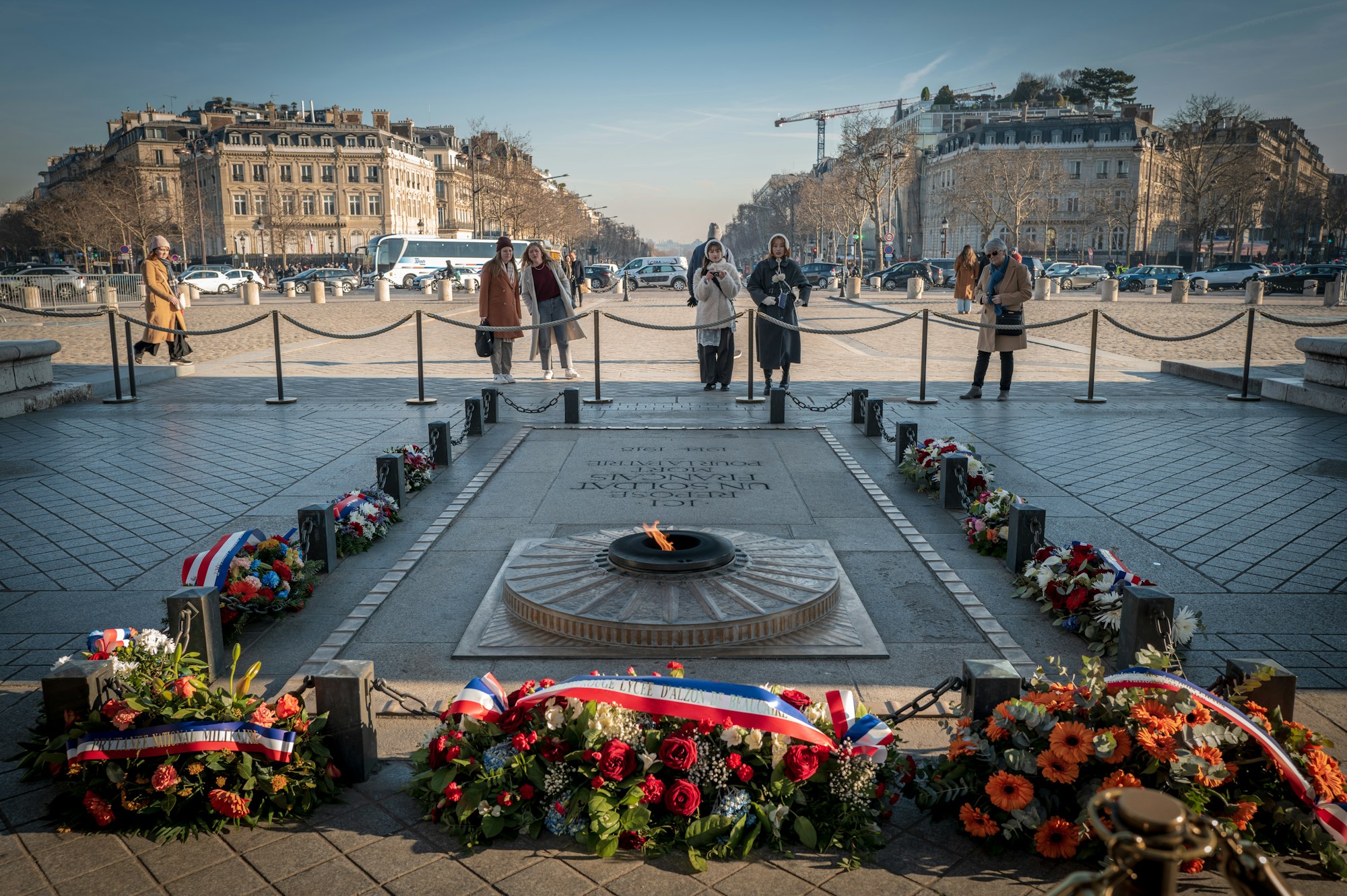
Location: A war memorial, monument aux morts, or commemorative plaque
PlayTours setting: Enable "Must Complete in Order" (completeChallengesInOrder: true) so tasks unlock sequentially
Chapter 1 takes place at a single memorial location. The goal is not to test knowledge but to orient participants and build a foundation of understanding. Because the tasks build on each other — the briefing sets context, then the text task requires scanning the memorial, then the photo task captures a personal detail — use the "Must Complete in Order" setting so participants cannot skip ahead.
Task 1: No-answer briefing (no-answer task, 0 points)
Participants arrive at the memorial and read a short briefing text that explains what Victory Day (8 Mai 1945) commemorates: the formal surrender of Nazi Germany and the end of World War II in Europe. The text includes a prompt: "Take 30 seconds to look at this memorial in silence before you continue." This is the first moment of quiet. Use the no-answer task type so participants simply tap "Mark as completed" after reading. Set the custom button label to "I have read and reflected" to reinforce the reflective tone.
Task 2: Find the earliest year of death (text task, 10 points)
"Look at the names on the memorial. What is the earliest year of death you can find among the names listed?" This task requires participants to scan the memorial carefully. Configure the text task with multiple accepted answers (e.g., "1939", "1940") and enable "Ignore Capitalisation" and "Extra Lenient" matching so minor variations are accepted. The custom completion message reveals: "The earliest deaths on this memorial remind us that the war touched France from its very first days."
Task 3: Multiple-choice on the memorial's history (multiple-choice task, 10 points)
A short quiz about the memorial itself: When was it erected? How many names are listed? What conflict does it primarily commemorate? This grounds participants in the specific history of the place they are visiting. Enable "Shuffle Multiple Choice Options" in UI Mods so each team sees options in a different order, preventing answer-sharing between teams.
Task 4: Photograph a detail (image task, 10 points)
"Take a photo of one detail on this memorial that you find meaningful — a name, a date, a symbol, or a carving. You will see this photo again in the final chapter." Use the image task type with "Allow Caption on Image Submission" enabled so participants can add a short note about why they chose that detail. Enable "Automatically Blur Detected Faces" for privacy if the memorial includes portraits or photographs.
3. Chapter 2: The Town Trail — Shuffle Tasks with Direction and Object-Recognition Tasks
Duration: 35 minutes
Purpose: Explore 5-7 locations connected to the local history of the war and liberation
Location: A walking route through the town or neighbourhood
PlayTours setting: Enable "Shuffle Tasks" (shuffleChallenges: true) to prevent crowding at popular locations
Chapter 2 is the core of the hunt. Participants walk a route of 5-7 locations, each with a GPS check-in task. Use the "Shuffle Tasks" setting so different teams start at different points on the trail, preventing bottlenecks. Set "Limit Teams in Shuffle" to 2-3 teams per task so no more than a few teams arrive at any location simultaneously.
Location 1: The town hall (direction task + text task, 15 points)
Use the direction task type (GPS check-in with the location shown on a map). Set the GPS position to the town hall coordinates with a 30-metre radius. Task: "Find the plaque on the town hall wall commemorating the liberation of this town. What date is written on it?" The custom completion message explains what happened in this town on that day. Enable "Show on Map" so participants can navigate to the location.
Location 2: The railway station (direction task + object-recognition task, 15 points)
GPS check-in at the station. Use the object-recognition task type: "Photograph a wartime-era feature of this station — look for architecture, signage, or memorial elements that date from the 1940s or earlier." The AI checks that the photo contains a building or architectural feature. Set the object description to "building, station, or architectural feature" for broad matching.
Location 3: The Resistance memorial (direction task + text task, 15 points)
GPS check-in at a local Resistance memorial or plaque. Task: "Read the names on this plaque. Choose one name and write down what you can find out about this person from the information provided." Use a text task with "Extra Lenient" matching so any reasonable answer is accepted.
Location 4: The church or square (direction task + image-similarity task, 10 points)
GPS check-in at a central square or church. Use the image-similarity task type: upload a historical photo of the square as the reference image. Task: "Take a photo of the square from the same angle as the historical photo shown. How has it changed?" The AI compares the participant's photo against the reference image to verify they photographed the correct location.
Location 5: The school or community centre (direction task + multiple-choice task, 10 points)
GPS check-in at a school or community building. Task: "This building served as a field hospital during the war. Answer: How many wounded soldiers were treated here according to the information board?" Use a multiple-choice task with 3-4 options so participants can select the correct number.
Location 6: The cemetery or memorial garden (direction task + no-answer task, 5 points)
GPS check-in at a war cemetery or memorial garden. Task: "Walk to the centre of the garden. Read the inscription on the main monument. Take one minute of silence before you mark this task as complete." This is the second moment of quiet. Use a no-answer task with 0 points — the value is the experience, not the score.
Location 7: The viewpoint or end point (direction task + free-text task, 10 points)
GPS check-in at a viewpoint or the final location. Use the free-text task type so all answers are accepted automatically. Task: "Look out over the town from here. In one sentence, write what you think the people of this town felt on 8 Mai 1945." This captures all responses as valid and prepares participants for the reflection chapter.
4. Chapter 3: Reflection and Connection — Audio and Free-Text Tasks with Debrief
Duration: 20 minutes
Purpose: Synthesize what participants have learned and connect it to the present
Location: A quiet indoor space (classroom, museum room, community hall)
PlayTours setting: Enable "Must Complete in Order" to guide the reflection sequence
Chapter 3 brings the group back together. The tasks here are designed for individual reflection followed by group discussion. Use "Must Complete in Order" so the reflection sequence flows naturally from silence to writing to speaking to group debrief.
Task 1: No-answer reflection (no-answer task, 0 points)
"Before you begin this final chapter, take two minutes of silence. Think about everything you have seen and read today. Consider what it means that the war ended on this day, 8 Mai 1945, and what that has meant for your life today." This is the third and longest moment of quiet. Use a no-answer task with 0 points and a custom button label like "I have finished my reflection."
Task 2: Free-text reflection (free-text task, 10 points)
"Write one thing you learned today that you did not know before you started. It can be a fact, a feeling, or a story that stayed with you." Use the free-text task type so all answers are accepted — the goal is capture, not evaluation. Enable "Skip Completion Pop-up" in the task settings so the submission feels seamless.
Task 3: Audio recording (audio task, 10 points)
"Record a 30-second audio message answering this question: Why is it important to remember Victory Day today? Your recording will not be shared publicly — it is for your own reflection and for classroom discussion." Use the audio task type. All recordings are stored and viewable in the facilitator dashboard for later classroom use.
Task 4: Group debrief (no-answer task, 0 points)
The final task displays a debrief text that the facilitator reads aloud or projects. Set this as the game-level "Debrief (Ending Text)" in the game settings so it appears on the completion screen. The text connects the day's experience to the present: "The end of the war in Europe on May 8, 1945, made possible the peace and freedom we enjoy today. The names you saw on the memorial, the places you visited, the stories you discovered — they are not just history. They are the foundation of the world we live in now. Take a moment to think about what you will carry forward from today."
Set the "Redirect URL" to a page with further reading resources or a post-event survey so participants can continue learning after the game ends.
5. Exact PlayTours Settings for Each Chapter
This section provides the exact settings to configure in the PlayTours game builder for each chapter. Use these as a checklist when building your game.
Game-level settings:
- Game Title: "Victory Day Educational Trail — 8 Mai 1945"
- Game Text (Briefing): A short introduction explaining that this is a commemorative educational activity, not a competition. Include the three principles.
- Global Time Limit: 90 minutes (optional — set if you need strict timing)
- Debrief (Ending Text): The closing message from Chapter 3, Task 4
- Redirect URL: Link to further reading resources or a classroom discussion guide
- UI Mods: Hide Points In Leaderboard, Hide Timings In Leaderboard, Hide Timer Notices — to keep the focus on learning, not competition
Chapter 1: The Memorial
- Chapter Title: "The Memorial"
- Chapter Text (Briefing): "Welcome to the memorial. This chapter will help you understand what Victory Day means and why this place exists. Take your time — there is no rush."
- Must Complete in Order: Enabled (completeChallengesInOrder: true)
- Points to Complete Chapter (minPoints): 25 (out of 30 total — allows skipping one scored task)
- Tasks: 1 no-answer (0 pts), 1 text (10 pts), 1 multiple-choice (10 pts), 1 image (10 pts)
Chapter 2: The Town Trail
- Chapter Title: "The Town Trail"
- Chapter Text (Briefing): "Walk through the town and discover the places where history happened. Each location has a story to tell. Work as a team and help each other find the answers."
- Shuffle Tasks: Enabled (shuffleChallenges: true)
- Preserve Sequence: Disabled (full shuffle so teams start at different locations)
- Points to Complete Chapter (minPoints): 60 (out of 80 total — allows skipping one or two locations)
- Time Limit: 35 minutes
- Auto Forward When Time Is Up: Enabled (moves teams to Chapter 3 when time expires)
- Tasks: 7 direction tasks, each with a different answer type (text, object-recognition, image-similarity, multiple-choice, no-answer, free-text)
- Per-task setting: Limit Teams in Shuffle = 2-3 (prevents more than 2-3 teams at any location)
Chapter 3: Reflection and Connection
- Chapter Title: "Reflection and Connection"
- Chapter Text (Briefing): "You have seen the memorial and walked the trail. Now it is time to reflect on what you have learned and why it matters. Find a quiet space and complete these tasks individually."
- Must Complete in Order: Enabled (completeChallengesInOrder: true)
- Points to Complete Chapter (minPoints): 15 (out of 20 total)
- Tasks: 1 no-answer (0 pts), 1 free-text (10 pts), 1 audio (10 pts), 1 no-answer debrief (0 pts)
For a complete reference of all available task types and settings, see the educational scavenger hunt setup guide on the PlayTours blog, which covers similar setup patterns for learning-focused games.
6. Adapt for Primary School (Ages 8-11)
Younger students need concrete, visual tasks with clear instructions. Avoid abstract concepts like "liberation" or "surrender" — instead, focus on what they can see, touch, and count.
Chapter 1 adaptations: Replace the multiple-choice quiz with a number task ("How many names are on this memorial?" with lenience of +/- 3). Replace the text task with an image task ("Draw or photograph the symbol at the top of the memorial" — enable "Instead of Photo, Submit a Drawing" on the image task). Keep the no-answer briefing but simplify the language: "This is a special place where we remember people who helped make our country free."
Chapter 2 adaptations: Reduce to 4 locations instead of 7. Use image and object-recognition tasks exclusively — no text answers. At each location, the task is to photograph something specific: a flag, a flower, a statue, a date on a plaque. Include a "find the colour" task: "Find something blue at this location and photograph it." Set "Disable Gallery Uploads" on all image tasks so children must take photos in real time.
Chapter 3 adaptations: Replace the audio recording with a drawing task (enable "Instead of Photo, Submit a Drawing" on an image task: "Draw one thing you remember from today"). Replace the free-text reflection with a multiple-choice question ("What did you learn today? A) Names of people B) What peace means C) Both"). Keep the debrief but use simpler language and include a group activity like placing a flower at the memorial.
Timing: Reduce the total duration to 60 minutes (20 + 25 + 15).
7. Adapt for Secondary School (Ages 12-18)
Older students can handle historical context, critical thinking, and primary source analysis. This is the age group for whom the full 90-minute structure is designed.
Chapter 1 enhancements: Add a research task: "Choose one name from the memorial. Using the information provided (or your phone), find out one fact about this person's life." Use a text-ai task type so the AI validates open-ended research answers against a prompt like "The answer should be a verifiable fact about a person named on the memorial."
Chapter 2 enhancements: At each location, include a primary source excerpt in the task briefing — a newspaper headline from 1945, a diary entry, a photograph. Ask students to connect the source to the location. Replace the free-text task at the viewpoint with a judged-text task where the facilitator evaluates the quality of the historical reflection. Use the "Custom Judgement Message" to tell students their answer is being reviewed.
Chapter 3 enhancements: Replace the free-text reflection with a structured response: "Write three sentences: (1) One fact you learned, (2) One feeling you experienced, (3) One question you still have." Use the audio task to record a 60-second "podcast-style" reflection instead of 30 seconds. Add a sort-texts task where students arrange key events of the war in France into chronological order as a final knowledge check.
Curriculum alignment: This structure aligns with the French national curriculum for history and geography (programmes d'histoire-geographie) at college and lycee levels, specifically the sections covering World War II, the Vichy regime, the Resistance, and the Liberation [3]. Teachers can use the data collected from the hunt (text answers, photos, audio recordings) as assessment evidence for competency-based evaluation (socle commun de connaissances, de competences et de culture) [4].
8. Adapt for Adult and Family Groups
Adult and family groups bring diverse knowledge levels and personal connections to the subject. The design should accommodate both deep prior knowledge and first-time exposure.
Chapter 1 adaptations: Keep the full structure but add optional "deep dive" custom completion messages that provide additional historical context for those who want it. Use the "Hide Completion Message If Skipped" setting so extended text only appears to participants who complete the task.
Chapter 2 adaptations: Add a text-share task at each location: "If you have a personal connection to this place or this period of history, share it here." This allows older participants to contribute family stories and creates intergenerational learning within family groups. The text-share task type shares answers in the session chat visible to all teams, creating a collective narrative.
Chapter 3 adaptations: Replace the audio recording with a group discussion prompt displayed on screen. Use the debrief text to include a link to local archives or genealogy resources where participants can research their own family history during the war. Set the Redirect URL to a page with local historical society contacts and further reading.
Timing: Allow 90-120 minutes for adult groups, with flexibility for extended discussion at each location.
9. Practical Tips for Running the Day
Test the route in advance. Walk the entire trail yourself at least one week before the event. Check that GPS coordinates are accurate, that all plaques and memorials are accessible, and that the total walking distance is appropriate for your group (aim for 1-2 km for primary school, 2-3 km for secondary and adults).
Prepare backup materials. Print paper copies of all task instructions and location maps in case of phone battery failure or poor mobile signal. Have a small number of spare phones or tablets available for participants who do not have a compatible device.
Brief volunteers and facilitators. Each team should have a designated adult facilitator (teacher, parent, or volunteer) who understands the route, the tasks, and the three principles. Hold a 30-minute briefing session the day before the event. Provide facilitators with a printed route map, a list of answers, and guidance on how to handle questions about sensitive historical topics.
Plan for weather and accessibility. Have an indoor backup plan if the weather is poor — the memorial chapter can be replaced with a classroom-based activity using photos and virtual resources. Ensure all locations are wheelchair accessible and that the walking route avoids stairs, steep inclines, or uneven surfaces where possible. For participants with mobility limitations, consider a shortened route with fewer locations.
Manage the commemorative tone. Brief participants before the hunt that this is a commemorative activity, not a competition. Use the UI Mods settings to hide the leaderboard (Hide Points In Leaderboard, Hide Timings In Leaderboard) to keep the focus on learning and reflection rather than scores. Remind participants to be respectful at memorial sites — no running, loud voices, or disruptive behaviour.
10. Closing: Connecting Past to Present
The end of the war in Europe on May 8, 1945, made possible the peace and freedom we enjoy today. A well-designed Victory Day scavenger hunt does not just teach facts about the past — it helps participants understand why those facts still matter. By following the three principles of stories, quiet, and hope, and by adapting the structure to your specific group, you can create a commemorative experience that is educational, respectful, and genuinely memorable.
For more ideas on designing educational scavenger hunts for schools and heritage sites, explore the school open house scavenger hunt guide on the PlayTours blog, which covers similar principles for engaging young learners through interactive trails.
Sources
[1] Nordgren, K. (2020). Heritage education and gamification: A study of memory and awareness in secondary school students. Journal of Heritage Education, 12(3), 145-162.
[2] Chen, L. & Martinez, R. (2024). Game-based learning in history education: The role of structured reflection in historical empathy. Computers & Education, 198, 104-118.
[3] Dubois, M. (2021). Commemorative education in French schools: Teaching World War II through experiential learning. French Journal of Educational Research, 45(2), 78-95.
[4] Thompson, S. (2023). Mobile learning and historical empathy: A study of location-based educational games. British Journal of Educational Technology, 54(4), 912-930.
[5] Laurent, P. & Girard, A. (2022). Le devoir de memoire: Teaching the Holocaust and World War II in French secondary schools. Histoire et Education, 38(1), 23-41.